Soma Tracker
Built my own tracker, then taught a bathroom scale to talk to it.
There's no shortage of apps for tracking a workout or a weigh-in. What changed isn't the market — it's the cost of building one myself: with AI-assisted development, going from "exactly what I want" to a working app stopped being a luxury. Soma Tracker was usable the same evening I started it, and has grown by a feature a week since. The sequel came a month later: the vendor app for my bathroom scale was friction I didn't need, so a second-hand Raspberry Pi now listens for the scale's own Bluetooth broadcast and hands each reading to an AI assistant, which decides whether it counts and logs it — no phone, no app, no typing.
- .NET 10
- SQLite
- Python
- Raspberry Pi
- Bluetooth LE
- Tailscale
Real screenshots of it running, not mockups.
-
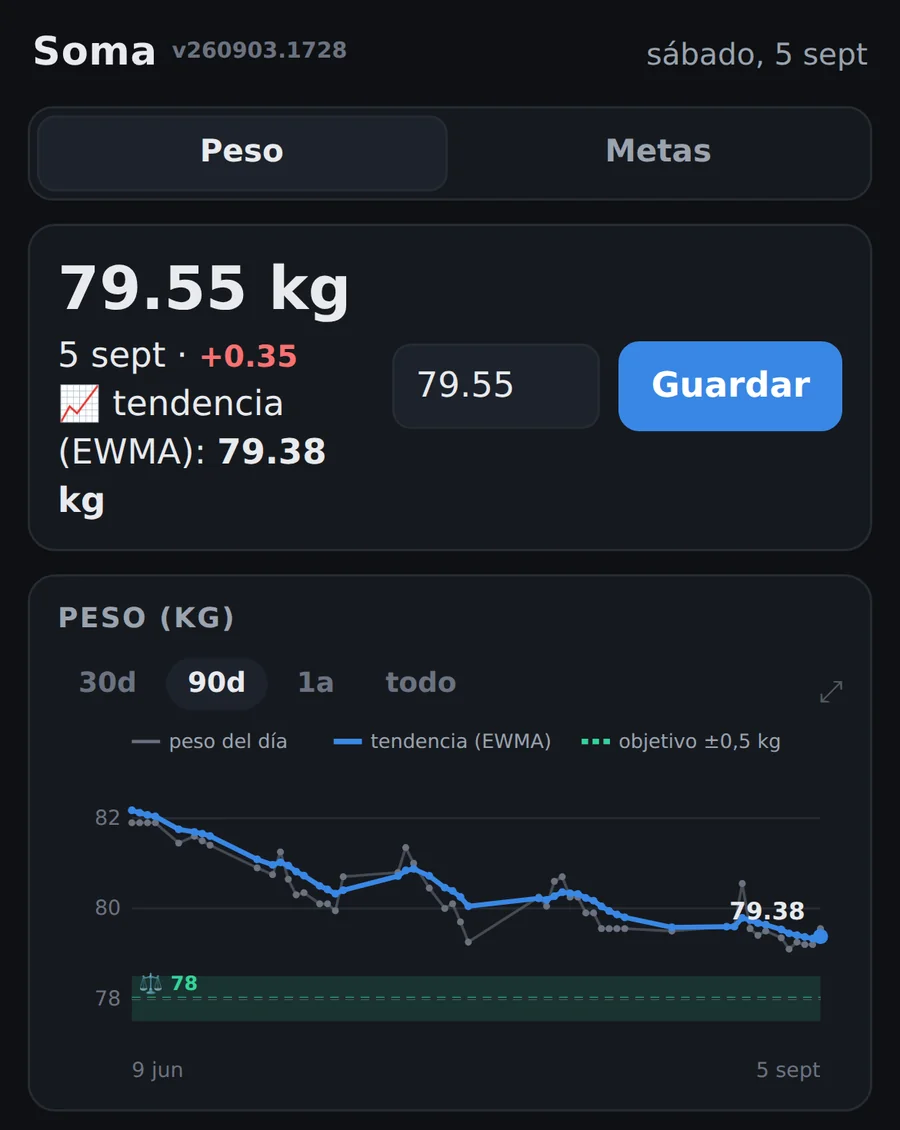
Weight logging with a trend I can trust: an exponentially weighted average that decays by elapsed days, not by number of readings, so a week without a weigh-in doesn't fake a jump.
-
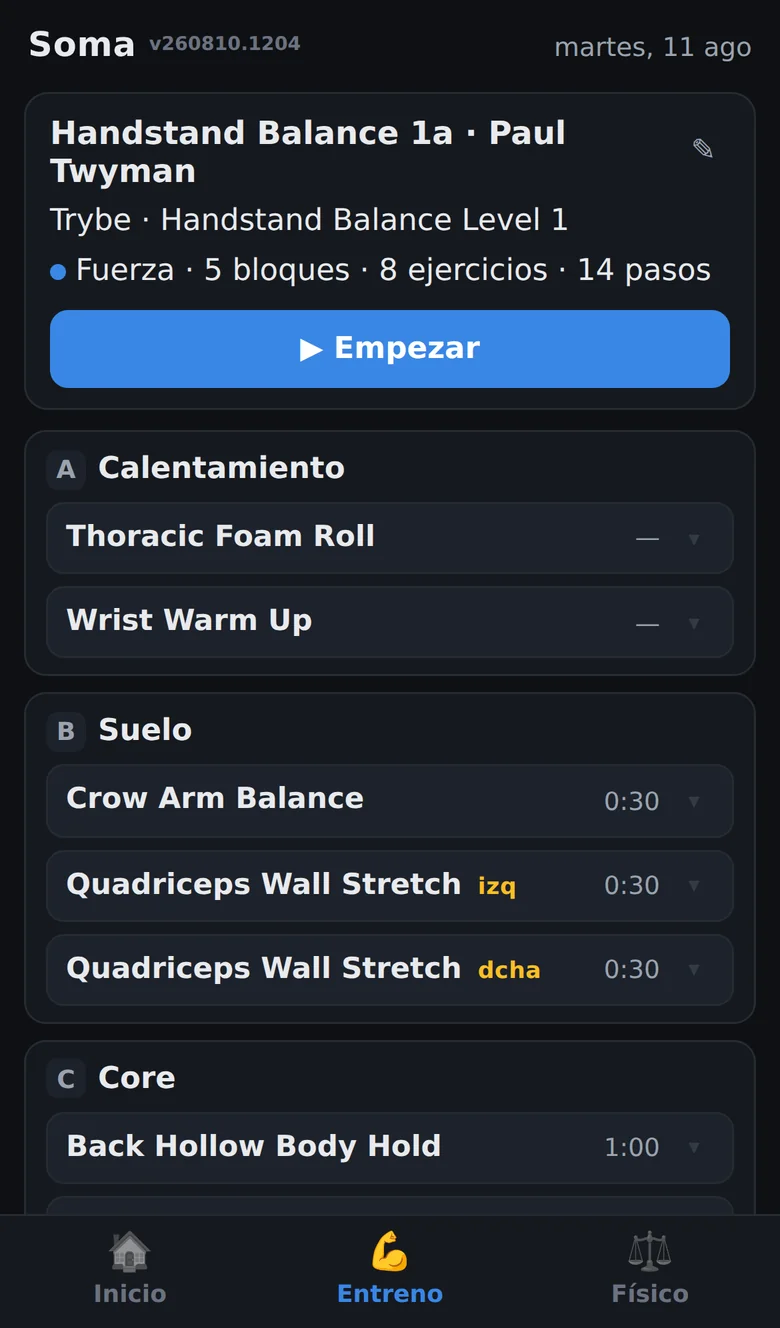
A guided workout player — blocks, sets, timed holds — that runs the session so I don't have to think mid-set.
-
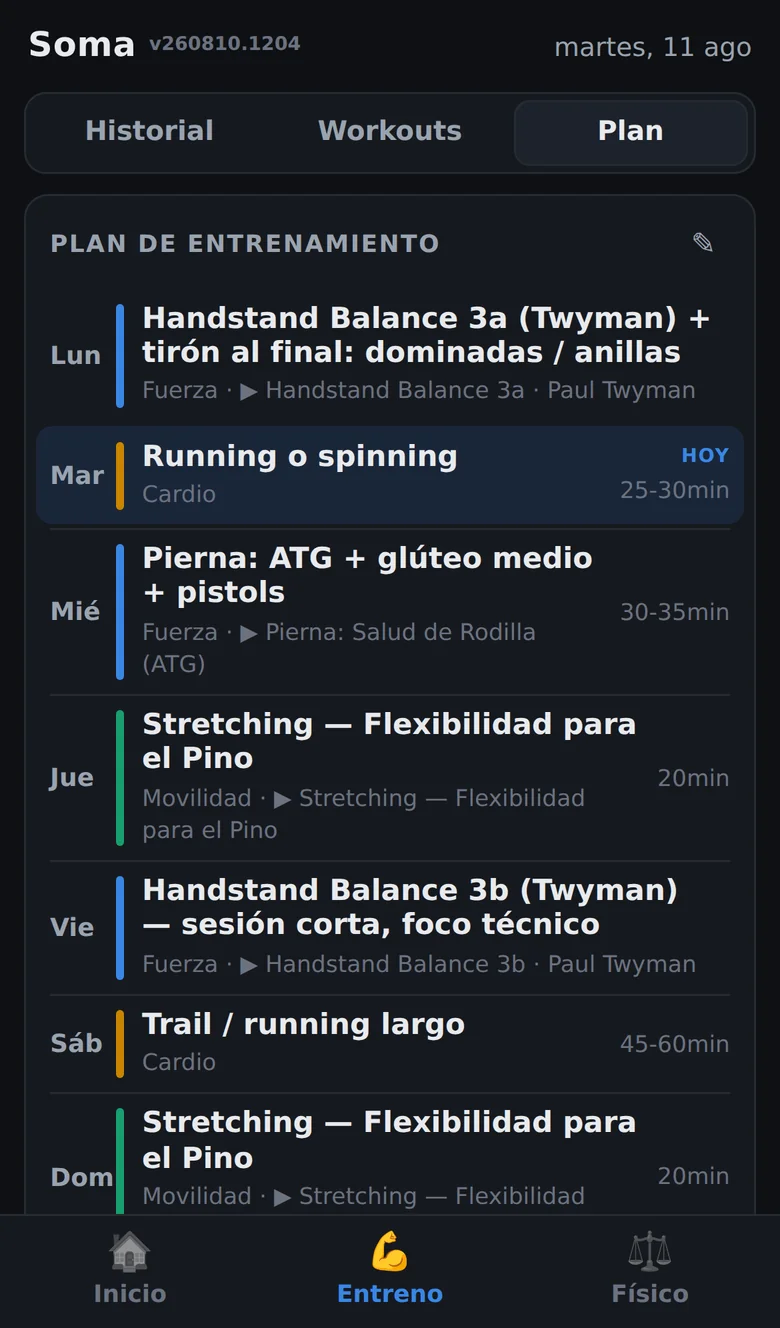
A weekly plan and goals, weight or exercise, with progress calculated live.
-
Weigh-ins arrive on their own: a Raspberry Pi hears the scale's Bluetooth broadcast, a small relay on my server logs it, and an assistant decides whether to store it — one weigh-in a day, the morning one.
-
My assistants use it without an integration: I say "ran 5k this morning" in a chat and it lands in the tracker; I ask how the month is going and the answer comes from the database itself.
-
Features arrive on my schedule: an idea mid-workout is a sentence to Claude Code that evening, and most of them are in the app before the next session.
The choices I made, and what they cost.
-
ASP.NET Core minimal API, no ORM
DecisionOne Program.cs, raw SQL via Microsoft.Data.Sqlite — one endpoint per resource, no controllers or DI ceremony I don't need.
WhyNothing between me and the database that I have to maintain, and the agent I build with reads the same SQL I do.
-
SQLite in WAL mode, designed agent-native
DecisionThe database is safe to read from outside while the app keeps writing to it.
WhyAn assistant can query it directly for reads with no API required — the integration surface for "connect this to my other tools" is a file, not a contract.
Trade-offWrites always go through the API, never a raw INSERT — it recalculates the weight trend, and a direct write would silently skip that.
-
Vanilla-JS PWA, no build step
Decisionindex.html, app.js, style.css and a service worker. No framework.
WhyInstalls to the home screen, works offline, and the edit-reload loop stays as short as possible when a feature idea shows up mid-workout.
-
On my own VPS, behind my own network
DecisionA systemd service on my server behind Caddy, reachable only over my tailnet — no public exposure, no accounts, no subscription.
WhyThe network is the perimeter, so there is no auth layer to build or maintain for a single-user app. It also puts the tracker on the same machine as my agentic assistants, which is what makes the next decision possible.
Trade-offIt's mine to operate: backups, updates and uptime are on me, and there is nobody to email when something breaks.
-
Dumb edges, smart middle (the scale integration)
DecisionThe Pi and the relay that connect the scale carry no credentials and no rules — they turn a Bluetooth broadcast into one message and hand it off.
WhyThe judgement — one weigh-in a day, a plausible range, what counts — lives in the assistant, in a paragraph of plain prose. Changing a rule means editing a sentence, not reflashing a device.
What custom actually buys you isn't the features — any decent app has features. It's that the data is a file on a machine I own and the API is a port on localhost, so my assistants need no plugin, no webhook and nobody's permission to use it: they read the database directly and write through the API. It's that a feature idea mid-workout is a sentence to Claude Code that evening, not a vote on someone's backlog. And it's that the data outlives the app — months of sessions in one file I can copy, query or hand to whatever I build next. That's also why the scale took days rather than a redesign: when the pieces are your own, the next problem is close to free to wire up.